
The evolution of music genres through the decades reflects changes in culture, technology, and societal values. Here’s a brief overview of how music genres have transformed from the 1950s to the 2020s:
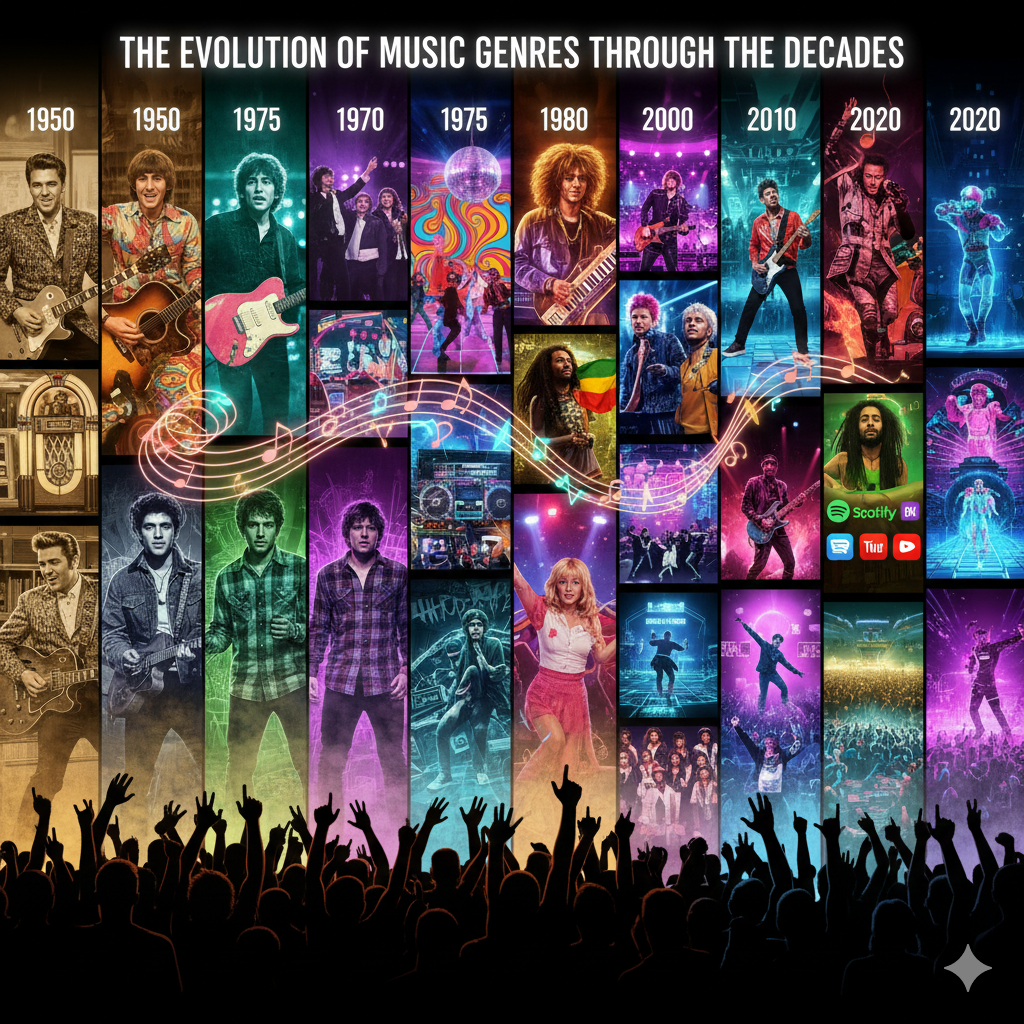
1950s: Birth of Rock and Roll
- Key Genres: Rock and Roll, Rhythm and Blues, Country
- Characteristics: The fusion of blues and country, with artists like Elvis Presley, Chuck Berry, and Little Richard becoming prominent figures. This era also saw the emergence of high-energy performances and youth culture.
1960s: The Explosion of Diversity
- Key Genres: Psychedelic Rock, Folk Rock, Motown, Soul, and the British Invasion
- Characteristics: The Beatles and the Rolling Stones dominated the British Invasion, while artists like Bob Dylan brought folk and rock together. Motown (e.g., Marvin Gaye, The Supremes) introduced a polished sound that appealed to a wide audience. The counterculture movement influenced psychedelic rock.
1970s: Experimentation and Fusion
- Key Genres: Disco, Punk Rock, Progressive Rock, Reggae
- Characteristics: The disco craze (e.g., Bee Gees, Donna Summer) brought dance music to the forefront. Punk rock (e.g., The Ramones, Sex Pistols) emerged as a reaction against the perceived excesses of mainstream music. Reggae gained international popularity through artists like Bob Marley.
1980s: Mainstream and Technology
- Key Genres: Synth-pop, Hip-Hop, Heavy Metal, New Wave
- Characteristics: The rise of MTV transformed the music landscape with the prominence of music videos. Hip-hop began to emerge from the streets of New York (e.g., Grandmaster Flash) and gained traction. Heavy metal also gained a massive following with bands like Metallica and Iron Maiden.
1990s: Globalization and the Rise of Alternative
- Key Genres: Grunge, Alternative Rock, Pop, Hip-Hop, R&B
- Characteristics: Grunge (e.g., Nirvana, Pearl Jam) brought a raw, unpolished sound that contrasted with the glam of the 80s. Hip-hop became mainstream with artists like Tupac Shakur and Notorious B.I.G. The emergence of boy bands and pop stars (e.g., Britney Spears, Backstreet Boys) defined pop music.
2000s: Digital Revolution and Genre Blending
- Key Genres: Emo, Indie Rock, EDM, Rap, Pop
- Characteristics: The advent of the internet and digital music changed how music was distributed and consumed. Genres began to blend more—artists like Linkin Park combined rock and hip-hop. EDM gained popularity in clubs and festivals, setting the stage for electronic-focused genres.
2010s: Streaming and Genre Fluidity
- Key Genres: Trap, Indie Pop, Lo-fi, K-Pop
- Characteristics: The rise of streaming services (Spotify, Apple Music) changed listening habits, allowing for more niche genres to gain exposure. Trap music dominated hip-hop, and K-Pop emerged as a global phenomenon with acts like BTS and BLACKPINK. Genre boundaries became increasingly blurred.
2020s: Continued Innovation and Social Impact
- Key Genres: Hyperpop, Alternative R&B, Global Fusion
- Characteristics: The 2020s have seen the rise of hyperpop and experimental sounds, as artists push the limits of genre conventions. Music continues to reflect social issues, with artists using their platforms for activism. The COVID-19 pandemic shifted live music dynamics, leading to virtual concerts and new ways of connecting with audiences.
Conclusion
The evolution of music genres is a continual process that reflects historical contexts, technological advancements, and cultural shifts. Each decade brings new sounds and innovations, leading to a rich tapestry of musical diversity that continues to grow and change.
About The Author
